Pickleball Rules for Beginners: The Basics Before You Play
The basic pickleball rules for beginners: court size, how to serve, the two-bounce rule, the kitchen and common faults, explained simply.
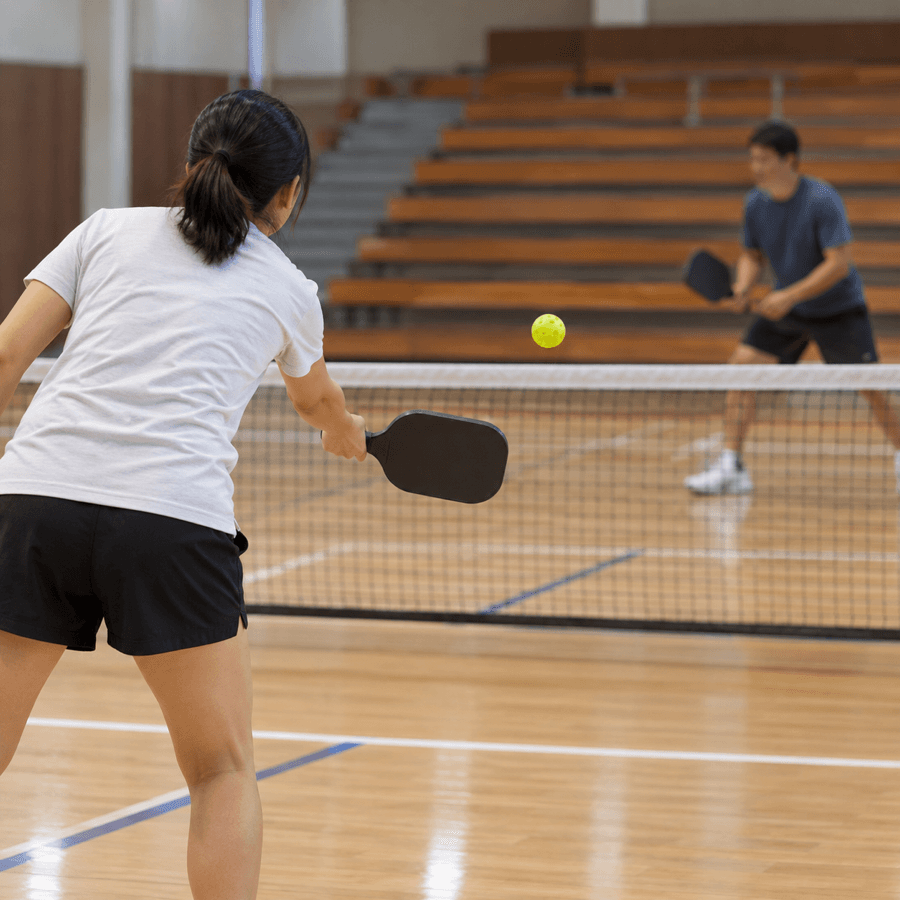
Pickleball is easy to pick up, but a few of its rules differ from tennis or badminton. If you are stepping onto a court for the first time, knowing the basics makes every game smoother and more fun for everyone. This article explains the pickleball rules for beginners in plain language: the court, the serve, the two-bounce rule, the kitchen and the faults that come up most often.
Contents
The court and basic equipment
A pickleball court measures 20 feet wide by 44 feet long, the same footprint as a doubles badminton court. The same size is used for singles and doubles. The net stands 36 inches high at the sidelines and 34 inches at the centre.
Parts of the court
- The kitchen: the area within 7 feet of the net on both sides.
- Right and left service courts: split by a centre line running from the kitchen to the baseline.
- The baseline: where players stand to serve.
Paddles and balls
Pickleball is played with a solid paddle, no strings, and a perforated plastic ball. Outdoor balls are usually harder with smaller holes, while indoor balls are softer. Some of our partner courts include paddles, some rent them, and some ask you to bring your own.
Serving rules
The serve starts every rally, and it is where many beginners slip up.
The volley serve
- Serve underhand, with your arm moving in an upward arc.
- Contact the ball below waist level.
- The paddle head must not be above your wrist at contact.
- At least one foot must be behind the baseline, and neither foot may touch the court until you hit the ball.
The drop serve
You may also drop the ball and hit it after it bounces. With this serve the waist and wrist requirements do not apply, which is why many beginners find it easier.
Where the serve goes
Serve diagonally into your opponent's service court. The ball must clear the kitchen. A serve that lands on the kitchen line is a fault. A serve that lands on the sideline or baseline of the service court is in. Each player gets one serve attempt, and a serve that clips the net and lands in the correct court is played as normal.
The two-bounce rule
This rule is a defining feature of pickleball and often confuses new players.
- The receiving side must let the serve bounce once before hitting it.
- The serving side must then let that return bounce once before hitting it.
- After those two bounces, both sides may volley the ball or play it off the bounce.
The rule stops the serving side from rushing straight to the net and gives every rally room to develop.
The kitchen, or non-volley zone
The kitchen is the area within 7 feet of the net on each side. Its rules are simple but strict.

What is not allowed
- You may not volley, meaning hit the ball before it bounces, while standing in the kitchen or touching its line.
- If your momentum after a volley carries you into the kitchen, that is still a fault, even if the ball is already dead.
What is allowed
- You can step into the kitchen at any time to play a ball that has bounced.
- You can stand in the kitchen when the ball is not in play.
The dink
Because volleying near the net is restricted, players often use the dink, a soft shot that drops into the opponent's kitchen. Dink rallies are one of the most enjoyable parts of pickleball.
Common faults
A fault ends the rally. The ones beginners run into most are:
- Hitting the ball out of bounds or into the net.
- Serving to the wrong court or into the kitchen.
- Breaking the two-bounce rule by volleying too early.
- Volleying with a foot on the kitchen line.
- The ball touching a player's body or clothing.
Line calls and the spirit of the game
In social play, each side calls the lines on its own half of the court. If you are not sure whether a ball was in or out, give your opponents the benefit of the doubt. That kind of honesty keeps pickleball friendly.
Tips for your first game
- Start with doubles. The court feels smaller and you have a partner to help cover space.
- Focus on getting the serve in, not hitting it hard. A safe serve is worth more than a fast one that sails out.
- After the third shot, work your way up to the kitchen line together with your partner.
- Call the score out loud before every serve so everyone knows where the game stands.
Wrapping up
Remember these five points and you are ready for your first game: serve underhand and diagonally, follow the two-bounce rule, never volley in the kitchen, know your lines, and play fair. The rest comes with experience. The quickest way to understand the game is to get on court and play a few games with friends.
Find a court near you on our courts board, or see the options for pickleball courts near Kuala Lumpur. When you are ready, send your date and time on WhatsApp, we check with the host and the host confirms the slot.