The Pickleball Kitchen (Non-Volley Zone) Explained
What the pickleball kitchen is, the volley and momentum rules, common beginner mistakes and how to play at the kitchen line.

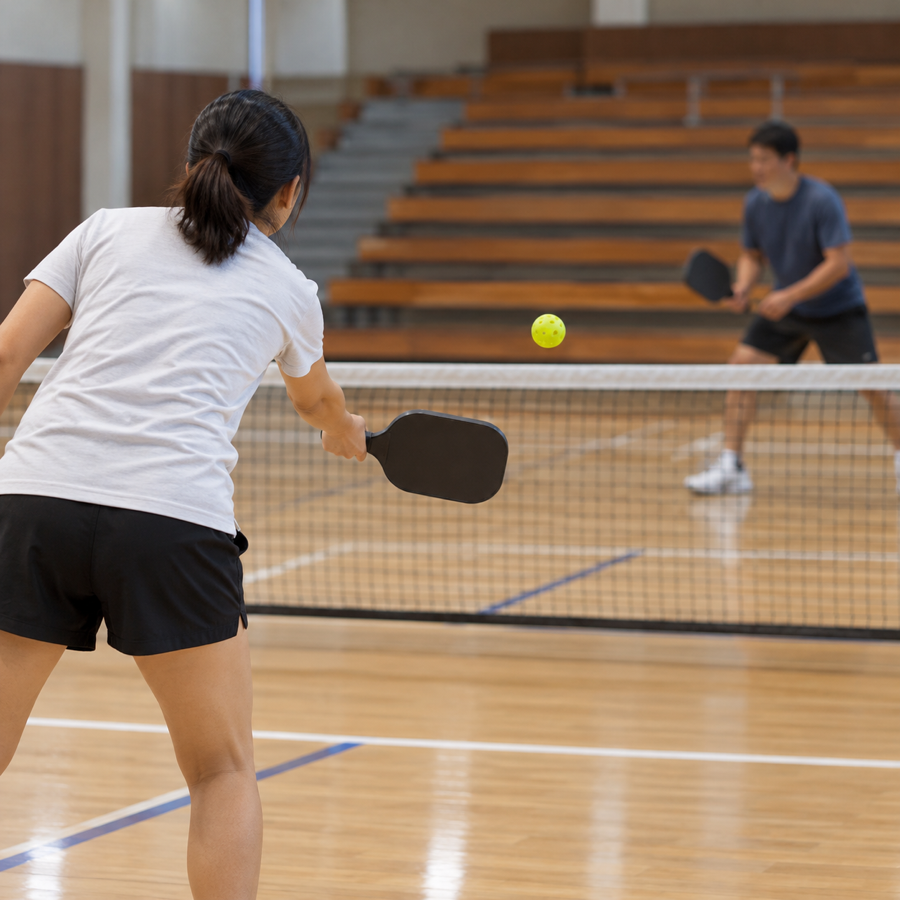
If you are new to pickleball, the word "kitchen" probably sounds odd. It has nothing to do with cooking. It is the small area in front of the net with its own special rules. The kitchen, officially called the non-volley zone, is one of the main reasons pickleball feels so different from tennis and badminton. This guide covers what the kitchen is, the rules you need to follow, the mistakes new players often make, and how to use the area to play smarter.
Contents
What the kitchen is
The kitchen is the rectangle on both sides of the net. It extends seven feet from the net and runs the full width of the court. The line that marks its edge is called the kitchen line or non-volley line, and that line counts as part of the kitchen.
Its purpose is simple: to stop players from standing right on the net and smashing every ball. Without the kitchen, the game would be all power at the net. With it, players have to rely on control, patience and soft shots.
The kitchen also ties in with the two-bounce rule. The serve must bounce once before it is returned, and the return must bounce once before the serving team hits it. Only after those two bounces are volleys allowed. That is why the serving team usually starts at the back and moves up to the kitchen line when the chance opens.
The basic kitchen rules
1. No volleys in the kitchen
A volley means hitting the ball before it bounces. You cannot volley while any part of your foot is inside the kitchen or touching the kitchen line. That includes jumping from inside the kitchen to hit a ball out of the air.
2. Momentum counts
If you volley from outside the kitchen but your momentum carries you into it, or onto the line, it is still a fault. It counts even if the ball is already dead before your foot lands. The same applies to anything you are wearing or carrying, including your paddle, if it touches the kitchen as a result of the volley.
3. You can enter the kitchen any time
Many beginners think the kitchen is off-limits. In fact you can step in and stand in the kitchen whenever you like, and you can hit a ball that has bounced there. The only thing not allowed is a volley.
4. Get fully out before you volley
If you have been standing in the kitchen, both feet need to be back outside it, and off the line, before you can volley.
5. The serve cannot land in the kitchen
Your serve must clear the opponent's kitchen. A serve that lands in the kitchen or on the kitchen line is a fault.
Common beginner mistakes
- Standing too far back. Worried about touching the line, many players hang well behind it. That leaves space for opponents to drop the ball at your feet.
- Volleying with a foot on the line. A foot touching the kitchen line is already in the kitchen.
- Stepping in after a volley. A volley swung too hard and forward often pulls players into the kitchen.
- Hesitating on bounced balls. Once the ball has bounced in the kitchen, you are allowed to step in and play it.
Playing at the kitchen line
Move up after the return
In doubles, the team that reaches the kitchen line first usually controls the rally. After the serve and return, work your way forward with your partner until you are close to the line.
Use the dink
A dink is a soft shot that lands in the opponent's kitchen. Because they cannot volley from inside the kitchen, a dink forces them to let the ball bounce and hit upward. That gives you the chance to wait for a higher ball to attack.
Stay in a ready position
Keep your knees slightly bent, paddle out in front and weight on the balls of your feet. This helps you react in fast exchanges at the net, often called a hands battle.
Talk to your partner
In doubles, move forward and back together, as if tied by a rope. If one of you is at the kitchen line and the other is far behind, a gap opens in the middle for opponents to aim at. Call "mine" or "yours" on balls down the middle so nobody hesitates.
Be patient
Dink exchanges can run for many shots. Players who stay patient and wait for a high ball tend to win more of these rallies than players who rush to hit hard.
Quick drills for your next session
- Cross-court dinks. Stand at the kitchen line opposite a partner and dink diagonally. Focus on keeping the ball low and controlled.
- Feet behind the line. While practising volleys, keep checking that your feet stay off the line.
- Volley and stop. Practise volleying while holding your balance, so your body does not carry into the kitchen.
These work well as a warm-up before games start. Find a nearby court on our courts board, or look at options for pickleball courts in Petaling Jaya and pickleball courts in Johor Bahru.
Wrapping up
The kitchen looks small, but it shapes the whole style of pickleball. Remember the key points: no volleys in the kitchen or on its line, momentum counts, and you can step in for a ball that has bounced. Once these basics are clear, you can start enjoying dink exchanges and net rallies. To book, send your date and time on WhatsApp, we check with the host, and the host confirms the slot.
WhatsApp RallyGo now to book a court and try these kitchen drills with your friends.